What happened here? Finding history where you are standing
A former factory entrance, a gap between houses or a faded inscription can make you stop in the middle of an ordinary walk. A location-based history app offers one way to find out more: it connects a place on a map with a story. Its usefulness depends on whether that particular place has been researched and included.
Give your question an address
Start with the street name and house number. Add anything distinctive: a name above the doorway, an old company sign or a date carved into the stone. Check whether you are looking at the main entrance or the side of a larger site. Those details make a much better search than “history near me”.
Then decide what you actually want to know. Was this building always a school? What occupied the empty plot? Who gave the street its name? A precise question helps you recognise an answer when you find one. A general account of Berlin may be interesting without explaining the building in front of you.
Where an audio story helps
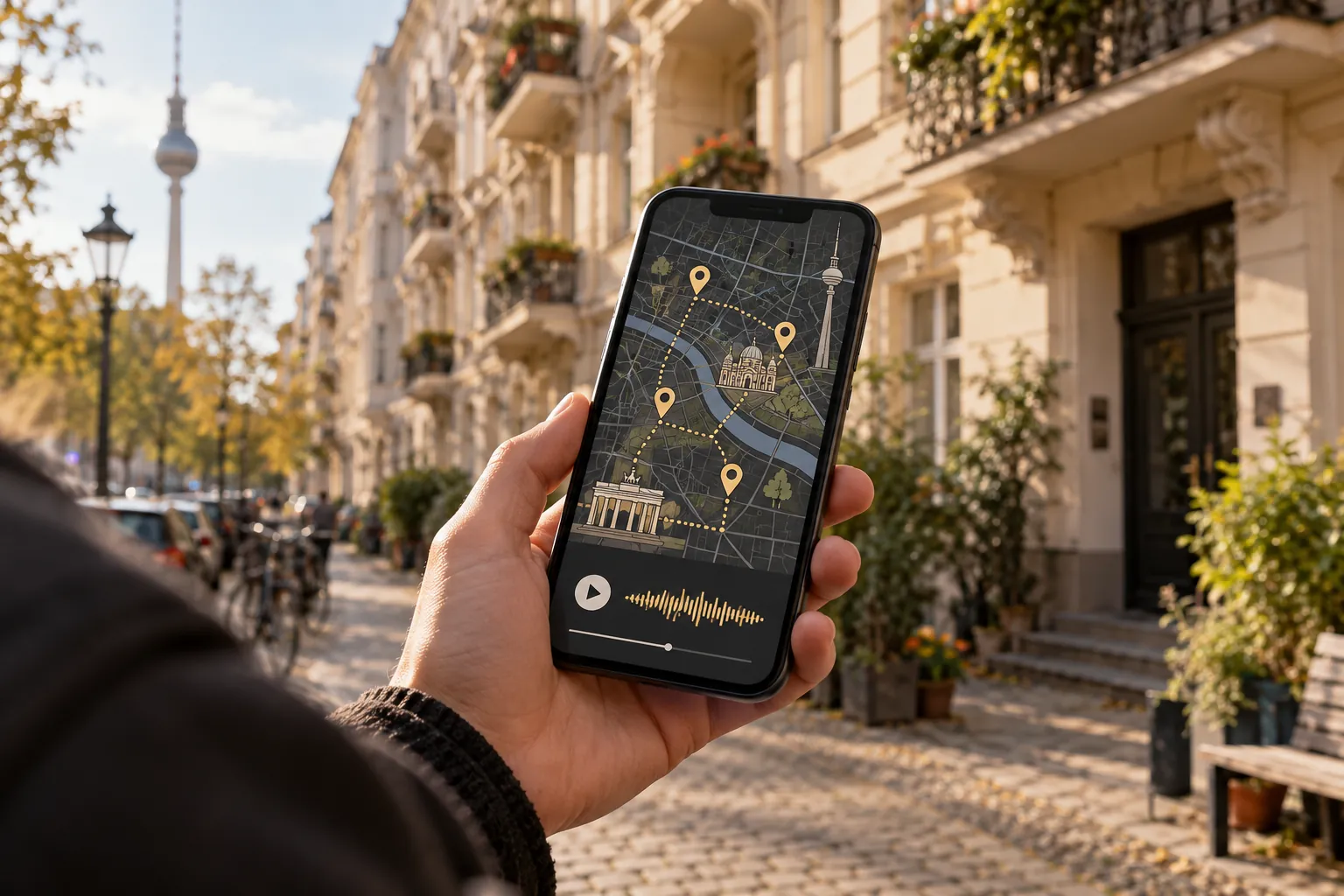
KiezWalk presents location-linked audio stories, including history and then-and-now perspectives. Listening can leave your eyes free to examine the surroundings. Before choosing a walk, check the stories currently offered in that area; a displayed street does not automatically have an associated recording.
Think of this as a starting point for discovery. If you need the history of one specific address, you may also need a building name, an institutional collection or an old photograph. An audio service and an archive answer different kinds of questions.
Our explanation of how GPS audio guides work covers the location mechanism. Being close to a map marker does not, by itself, establish a historical fact.
Look again after listening
Find somewhere comfortable to stop, listen to one story, then look for a detail you can match: the line of an entrance, the shape of a roof or the position of a street corner. This turns a description into something you can picture.
If the account seems inconsistent with the view, check the date, address and viewing direction before drawing a conclusion. Buildings and street names change; a photograph may show the same location from an unfamiliar angle. Use our guide to finding historical photographs of Berlin streets when you want a visual comparison.
Keep the unanswered question
Take your own reference photo and save the address alongside the question. “The entrance at this corner” is much easier to investigate later than “somewhere in Kreuzberg”. For stronger claims, follow the steps for checking local history sources.
You do not need a definitive answer at every stop. One well-observed place can give you a reason to return, and a specific question can make a familiar street interesting again.